E44: 3,500 Customers and Zero Outbound with Shaan Arora
In this episode we talked to Shaan Arora, the co-founder of Alia, about bootstrapping Alia Popups from $1M to $9M ARR in a year, bootstrapped, with zero outbound, and no venture capital.
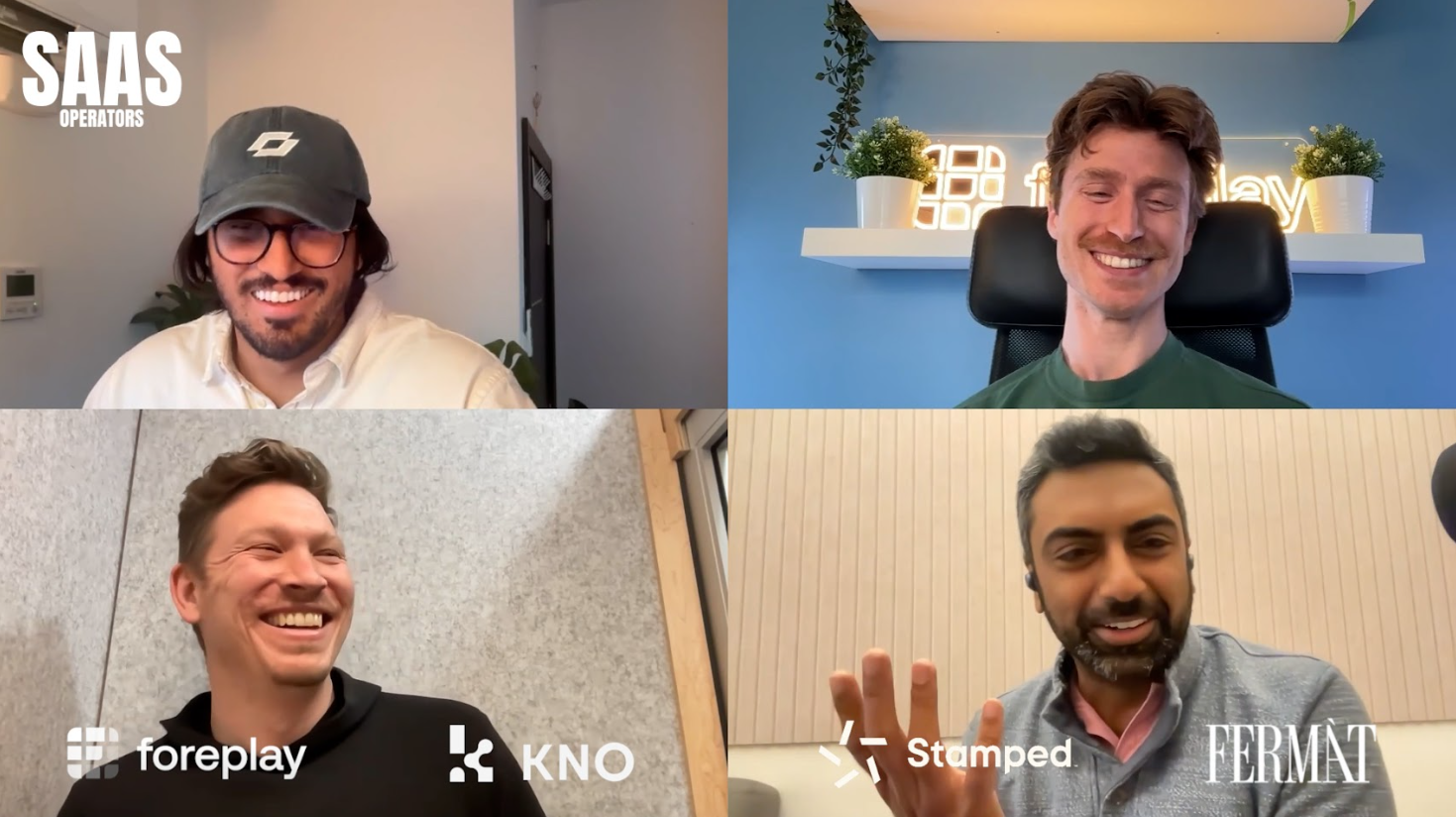

In this episode of the SaaS Operators Podcast, we talked to Shaan Arora, the co-founder and CEO of Alia Popups, and get a live look at what it looks like when someone builds in a decades old category, does it better, and lets the market come to him.
Shaan went from $1M to $9M ARR in twelve months without raising a dollar or running a single outbound campaign.
The real question is what happens when your product is so visible that brands right click and inspect element on sites they like, find your name in the code, and sign up.
The conversation starts with a simple observation. 60% of revenue comes from agency partners. ACV 3x'd because bigger brands started showing up on their own. And Shaan didn't change a single thing about his go-to-market.
And the implication is obvious.
If you're better than what exists in an established category, your customers will find you. The question is what you do once they show up.
The Growth Loop Nobody Planned
60% of Alia's revenue comes from agency partners and 40% is word of mouth and referrals, with zero outbound until this year.
The wildest part is the inspect element thing. Brands see a pop-up they like on a site , right click, inspect element, see Alia in the code, look it up, and sign up.
For his next company, Shaan wants that same property baked in. If someone likes what they see, they can figure out who made it.
If someone cares enough to right click and look under the hood, they're already a high intent lead. Nobody asked them to do that, they chose to.
Nobody designed that funnel. The product was visible and good enough that people found it on their own.
Think about that for a second. The best growth channel Alia has is people reverse engineering websites to figure out what software is running on a site they admire. You can't buy that with ad spend.
ACV 3x'd Because Better Customers Found Him
Alia’s customer count went from 1,100 to 3,500, roughly 3x, and ACV also 3x'd in the same window which is the more impressive stat.
There was no specific go-to-market change. A year ago they had a million in ARR and nobody knew who they were. As they grew and bigger brands started trusting them, bigger deals followed and it was completely unintentional.
Brands like Nike Strength and Graza are interested now, but two years ago when Alia had no recognizable names on the roster, those same brands probably wouldn't have looked twice. Bigger brands want to see other bigger brands using the tool before they commit, and once a few do, the rest start showing up on their own. That's how momentum works and there's no playbook for it, it's just what happens when you're good and visible long enough.
Depth Of Scale Beats Breadth Of Scale
Here's a stat from the podcast that reframed the entire conversation. Three enterprise customers at one company represent the same GMV as thousands of Shopify brands combined.
Bigger customers force you to build things you'd never think of on your own. A brand with a hundred person product team has already invested heavily in sophisticated experiences. They know what good looks like and they'll push your product to the edge of what's possible.
A brand without a product team and only have a small marketing team, uses what you give them, which is fine for revenue and limited for learning.
Depth of scale is more important than breadth of scale because you're more likely to be at the edge of innovation with depth. Enterprise customers force you to solve harder problems and solving harder problems compounds into a better product for everyone.
Wayfair, Target, Tapestry, their digital product teams are massive and they do interesting things. The rest of the industry follows from there.
Your Business Is Already Telling You What To Do
There's an internal debate at Alia about moving outside Shopify. More money outside Shopify, bigger universe, more customers, more revenue. But is it worth the R&D investment to build integrations for other platforms?
The answer is simple, your business is already telling you what to do, just follow the line.
The ACV 3x'd with all new customers. Those customers are bigger and that trajectory points outside Shopify eventually.
Armchair debates have no place in business and that's the best thing about business. Researchers and politicians can argue theory all day and founders just do stuff and customers buy or they don't.
The business already decided and you just have to listen to it.
Expectations are lower outside of Shopify too. If you’re working with someone on BigCommerce or WooCommerce and the product doesn't work exactly as well as the Shopify version, it's still better than what they have and the bar is low.
The caveat is when you get to large enough enterprises with large enough SKU counts, it inverts. The Salesforces of the world actually serve them better in some cases and the way most people in ecom SaaS talk about platforms is very different from how large brands and retailers talk about it.
The Agent Question
What happens when someone spins up an LLM, connects it to Shopify and Twilio, and just does the thing your software does for a penny per message?
Some fraction of people will absolutely do this but the real job of a software vendor was always economies of scale and knowledge across customers.
Take learnings across your base and propagate them back out. In SaaS, that means programming insights directly into features and in an AI world, you can learn things contextually which is way more powerful.
The most sophisticated buyers were never paying for the tools. They were paying for accumulated knowledge and economies of scale and that doesn't change because someone can spin up an API call.
People could make their own pop-ups but how optimized is it going to be and do they have learnings from thousands of brands? Alia does.
Context Is The Moat
You sell makeup between $10 and $20 and your customers are coming from a Meta ad. There's a specific pop-up design, timing, and behavioral pattern that works best for that exact scenario.
An LLM can understand all of that and implement it, but that makeup brand has no idea the insight exists.
The company that's worked with thousands of brands across every category, price point, and traffic source knows it, and that knowledge compounds because every new customer makes the data set richer.
Someone can vibe code your product from a year ago and they can't vibe code your data.
Now imagine your pop-up tool knows that dark mode at nighttime from Facebook ads might convert better and it tests that without you even thinking about it. Testing that as a human? Nobody is doing that and nobody wants to do that, but if an app just did it, that app's incredible.
Alia already has some of this with smart testing that runs on AI. They're building smart offers where different shoppers see different discount amounts based on what it takes to convert them. The agentic future is showing up in pieces and the question is who has the data underneath to make those pieces work.
Credit Suisse To $9M ARR
Shaan is 24 and started building Alia at 20 as a computer science and business major who interned at Credit Suisse in the quant world.
He woke up miserable every day knowing he had to go in and work at a bank and felt completely worthless. He felt that if he died tomorrow, nobody there would care.
That feeling was so resonant that the decision became simple, do whatever it takes to work for yourself.
After college, full time with Alia, they had two customers. One was his co-founder's cousin and one was a girl from class who begrudgingly agreed to use the app for $20 a month.
Every day for three hours, going on Etsy, commenting on sellers, asking for advice on his company and getting 40 Etsy accounts blocked doing the most tedious, brain dead work you can imagine. Stuff you probably wouldn't even give to a VA.
But he loved every second of it because it was for himself.
That's the thing about direction. When you have a problem worth solving, the quality of the work doesn't matter. You'll do the worst tasks imaginable and love it because you chose them.
The problem was simple, he’d be going back to Credit Suisse if he stopped, so he didn't stop.
What He Actually Wants
What’s the objective with building Alia?
Building is great and freedom is great, but what matters more to Shaan is working with his co-founders. Cory, Bill, and their founding engineer all push each other every day.
Shaan’s favorite thing is feeling stupid, having to go in and try to impress his co-founders and loving that.
He'd be happy building any company with his friends as long as two things are there, he’s working for himself and learning from people who are smarter than he is.
If those two things are there, the specific company matters less than the conditions.
A lot of founders overcomplicate this and think they need to be passionate about the product category. Shaan is passionate about the conditions of his life and the pop-up space happened to be the vehicle. If it was something else, with the same people and the same freedom, he'd be just as happy.
Pick a good problem and pick good people and everything else will follow.
Capital As A Weapon
Shaan tried to pitch a pre-seed and VCs said the vision wasn't big enough, so he bootstrapped. Now at $9M ARR and the growth equity guys are calling.
The thing is, he can make up whatever deal he wants right now. Sell a piece, give liquidity to the team, take investment on his terms and the total number of investable companies in this category is small so the leverage is real.
One of the main jobs of a CEO is figuring out how to use capital as a weapon for yourself, your people, and your customers. What would capital do for each stakeholder? Then go get it done.
The trajectory might continue for a long time and it won't continue forever because open windows close. Public market multiples are compressed right now too and the range of 15 to 200 million depending on the buyer was generous at the top end.
Doesn't change the leverage, just changes the math.
The Pop-Up Category Is Decades Old
Pop-ups aren't a new category, everyone already has one and everyone knows theirs could be better.
The TAM math is straightforward. 130,000 Shopify brands doing over a million in GMV and about 85% use email and SMS as a channel. That's roughly 100,000 brands and maybe 20% are willing to pay for a better pop-up tool, which is 20,000 brands on Shopify alone with another 15 to 20,000 outside Shopify.
The pitch is simple, your pop-up could be better, give us a try and we'll make it better.
No category creation required, just innovation on something that already exists and has been mediocre for a long time. When the buyer already knows they have the problem, the job is showing them you solve it better than what they have.
And when the product is visible on every site that uses it, the proof is sitting right there in the inspect element.
